Sealcoating Madison WI Call (608) 530-6894
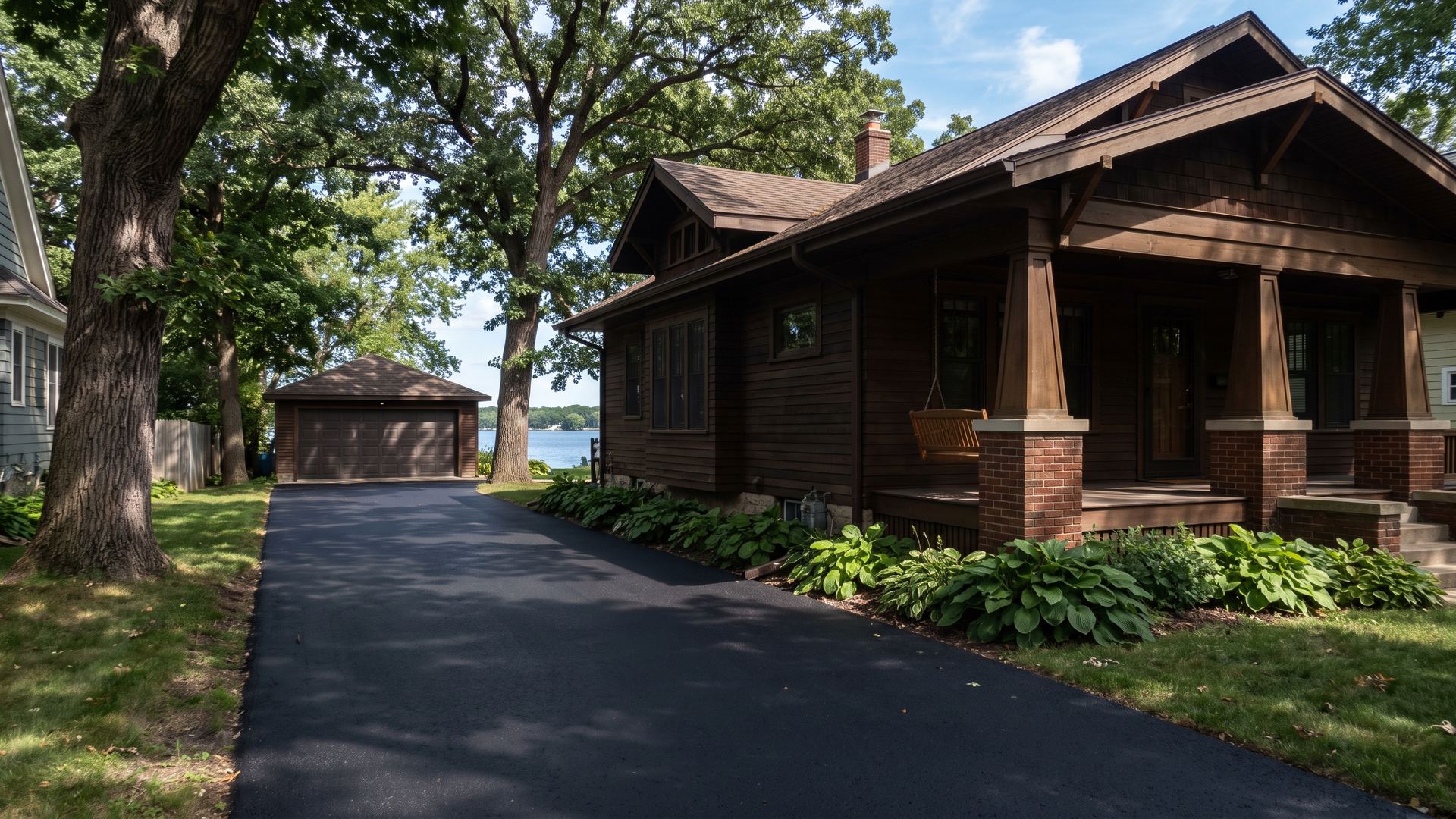
Towering trees shade fresh black sealcoat on a side drive by a brown craftsman bungalow, lake water glinting past the garage

Sealcoating Madison WI

(608) 530-6894

Free Madison quotes for driveway and lot sealing.

Asphalt Sealcoating for Madison's Four-Lake Winters

Pavement at the county's airport weather station thaws by day and refreezes by night on about 87 days a year, and county law has barred coal tar sealer since 2007. Here is what that means for a driveway, and what the work costs.

  • About 87 days a year cross the freezing line at the county airport (NOAA 1991-2020)
  • Coal tar and high-PAH sealers banned countywide since July 1, 2007 (Dane Co. ch. 80)
  • Half of city streets are salt routes; Lake Wingra chloride reached 129 mg/L in 2022
Why seal here

What 87 freeze-thaw days a year do to Madison blacktop

Blacktop in this city spends a long season caught between thaw and refreeze. NOAA's 1991-2020 normals for Dane County Regional Airport count about 148 nights a year when the low drops to 32 or colder but only about 61 days when the high never gets above it, which leaves roughly 87 days when the surface thaws in the afternoon and freezes again after dark. Water that has soaked into a weathered, porous drive expands on every one of those nights. Seal coating does not fix a failed base; it closes the top of sound pavement so meltwater and brine run off instead of in.

A county rule settles the product question before anyone opens a bucket. Chapter 80 of the Dane County Code has barred applying, selling or displaying coal tar sealers since July 1, 2007, and its current text, last amended in 2018, also reaches any pavement sealer whose PAH content tops 0.1 percent by weight. Driveway sealing here therefore means an asphalt emulsion or an acrylic coat, and the real questions are preparation, weather and the number of coats. The coal tar guide quotes the ordinance and lists what to ask a crew.

The housing stock sets the workload. The 2019-2023 American Community Survey counts 133,530 housing units in the city with a median build year of 1980, ranging from 17,310 homes built in 1939 or earlier to apartment buildings of 50 or more units that hold 15.7 percent of the total. A narrow drive beside an old house, a 1990s suburban driveway and a large apartment lot need three different plans. Sourced price ranges sit on the cost page, and anything sent through the quote form is handed to independent contractors who work locally.

Free quote

Fields marked * are required.

Fast response during business hours. No obligation.

The work

Coal-tar-free sealing, crack filling and lot work in Dane County

Newly sealed near the sidewalk and faded gray back to the garage, the driveway runs beside a sage green craftsman bungalow with hostas

Driveway Sealcoating

Two coats of coal-tar-free sealer on a home driveway after sweeping, washing and crack filling, timed to the late-May to September window and to Dane County's Chapter 80 rules.

Typical: Madison figure: $230 - $380 for a 24 x 30 ft drive, about $0.30 - $0.50 per sq ft

Pink coneflowers and black-eyed Susans border a gray driveway where glossy black crack filler traces a long, winding line in low sun

Crack Filling

Rubberized hot-pour material packed into every crack a quarter inch or wider, laid before November's freeze-thaw run and again once March, the peak freeze-thaw month, is over.

Typical: HomeGuide: $0.50 - $3.00 a linear ft; Angi: many standalone jobs $100 - $400

Hostas in lavender bloom and ferns spill over a dry-laid limestone wall where new asphalt fills a saw-cut section of the driveway edge

Asphalt Patching

Cutting out soft spots and potholes and replacing them with compacted hot-mix asphalt, so the base holds through spring thaw and the whole drive can be sealed as one surface.

Typical: HomeGuide: patching $2 - $5 a sq ft; one pothole, call-out included, $100 - $400

Crisp stall lines on new sealcoat fill a lot beside a red brick corner building, a faded gray strip still unsealed in front

Parking Lot Sealcoating

Sealing apartment, condominium, church and business lots with coal-tar-free product, planned around tenants and a short season, with the accessible-stall check that a reseal brings with it.

Typical: FixAsphalt: $0.14 - $0.50 a sq ft; a 4,000 - 7,000 sq ft lot about $1,200 - $2,100

Yellow daylilies and tall grasses fill a curbside bed above new sealcoat marked with white stall lines and a hatched no-parking zone

Line Striping

Stall lines, arrows, fire lanes and accessible stalls painted on sealed or existing lots, laid out to the ADA scoping table that a reseal brings into play.

Typical: Restripe $4 - $5 a stall; accessible stall $25 - $40; setup $150 - $350 (HomeGuide)

Under big spreading trees, a craftsman-style building with tapered columns overlooks fresh sealcoat and white lines, purple blooms and a lake beyond

Asphalt Maintenance Plans

A yearly schedule for lots and long drives: spring sweep and inspection, fall crack filling, resealing every few years, restriping and a winter salt plan, all timed to local seasons.

Typical: Billed by the visit: cracks $0.50 - $3.00 a linear ft; lot sealing $0.14 - $0.50 a sq ft

Why this site starts from the airport station and Chapter 80

Numbers from the airport station

Seasonal advice on this site comes from NOAA's 1991-2020 normals for Dane County Regional Airport: roughly 87 freeze-thaw days, a May 2 median last freeze, an October 5 median first freeze and 50.9 inches of snow. A schedule written for a milder city would have crews sealing too early in spring and too late in fall, when nights are too cold for a coat to cure.

Written around Chapter 80

Every sealer discussed here is one Dane County allows. The guide quotes the county ordinance itself, including the 0.1 percent PAH limit and the daily-offense clause, so a property owner can hold a crew's product up against the actual rule instead of a sales sheet.

Prices with their sources

The cost page lists observed ranges from named cost guides, including a Madison-specific figure, and says which guide backs each row. None of it is a quote. The point is to know whether a written bid sits inside the market before anyone signs it.

Independent crews, written scopes

This site does not seal, patch or stripe anything. Whatever arrives through the quote form is forwarded to independent contractors active in Madison and the neighboring Dane County cities, and the property owner compares their written scopes and decides whom to hire, if anyone.

Job sequence

How a Madison sealing job should run, from thaw to cure

  1. Walk the pavement after salt season

    Late April or early May, once the plow ridges have melted, is the time to look. March's roughly 19 freeze-thaw days are the likeliest to have opened cracks. Note every crack wider than a quarter inch, any spot that flexes under a tire, oil stains and edges the plow blade chewed. Sweep up the winter sand before judging the surface.

  2. Fill cracks and patch before any sealer

    Cracks over a quarter inch get hot-pour filler, the same threshold the UW-Madison PASER manual uses for sealing road cracks, and soft areas get cut out and patched. Fresh asphalt should sit 30 to 60 days before any sealer covers it, so a patch laid in June is ready well before the season ends. The crack filling page covers the details.

  3. Confirm the product, then apply two coats

    Before the drums open, the crew should name the sealer and confirm it is an asphalt emulsion or acrylic under Dane County's 0.1 percent PAH limit. Manufacturer instructions ask for clean pavement, primed oil spots, a full day of 50-plus temperatures that keep climbing, a dry forecast for the day after, and two coats with clean silica sand blended in.

  4. Keep traffic off, then plan the next cycle

    Cars stay off for 24 hours after the final coat. After that the plan is simple: walk the drive again each spring, fill new cracks before winter, and reseal when the surface turns gray and porous, which Angi puts at every two to five years for most sealants. Book early, because the local window is short.

Local ground

Silt loam, salt routes and lake chloride: conditions in Madison

Frost dates frame the working calendar. At the airport, half of all springs have seen their last 32-degree night by May 2 and half of all autumns their first by October 5, a 152-day frost-free stretch in a typical year. The same normals spread the freeze-thaw days unevenly: about 19 in March, 15 in November, 12 each in December and February, 10 each in January and April, and 8 in October. Snowfall averages 50.9 inches, 37 of them from December through February. A fresh coat wants the thermometer at 50 or better and climbing for a full 24 hours, and normal lows clear 50 only from June through September (May's is 46.1), so the dependable sealing weeks run from late May into September.

Under the lawns is glacial ground. The Dodge soil series, whose official type location lies a few miles northeast of Sun Prairie, is typical of the county: 24 to 39 inches of wind-blown silt loam over silty clay loam, then loamy till on moraines and drumlins. Soils with that much fine material are what pavement engineers call frost susceptible, and heave needs only three ingredients: fine soil, freezing temperatures and a water supply. On the far west side the land climbs onto a terminal moraine of the Green Bay Lobe along Pleasant View Road, the city's highest ground, and the western suburbs sit at the edge of the unglaciated Driftless Area.

Age shows in the pavement. Of the city's housing units, 13.0 percent were built in 1939 or earlier and another 24.8 percent between 1940 and 1969, according to the 2019-2023 American Community Survey. Detached single-family houses make up only 39.9 percent of the stock, while buildings with 20 or more units hold 28.7 percent, and Census QuickFacts puts owner-occupancy at 46.0 percent for 2020-2024. For asphalt, that means a large share of local blacktop is apartment and condominium parking, where a property manager signs off on sealing, restriping and the accessible stalls that a reseal brings into play.

City plows hit the salt routes, about half of all streets, every time snow accumulates, and plow every street once a storm ends with more than 3 inches down. From November 15 to March 15, alternate side parking applies from 1 to 7 a.m.; inside the Snow Emergency Zone, which covers the downtown isthmus and neighborhoods such as Marquette, Tenney-Lapham, Vilas and Bay Creek, it applies only during a declared emergency. Under MGO 10.28, sidewalks and curb ramps must be cleared by noon the day after the snow stops. Across more than 1,800 miles of traffic lanes, those rules decide where a crew can park and how often a plow ridge lands across an apron.

Salt is a pavement story and a lake story at once. Public Health Madison and Dane County's 2022 road salt report measured chloride at 129.0 mg/L in Lake Wingra, 75.9 in Monona, 75.7 in Waubesa, 71.6 in Kegonsa and 57.7 in Mendota, where natural Wisconsin water runs under 10 mg/L. City salt use fell from 16,351 tons in 2013 to 6,124 tons in 2022. The city's own guidance says a 12-ounce coffee mug of salt treats 10 sidewalk squares and that salt stops working below 15 degrees. Less salt on a drive means less brine working into cracks and less residue to wash off before the next seal coat.

Two local rules touch nearly every job. Dane County's Chapter 80 applies in all areas of the county, so no coal tar or high-PAH product may be applied, sold or displayed anywhere from Middleton to Sun Prairie, and each day an illegal coating stays on a property counts as a separate offense. In the city, the street terrace permit covers residential driveway aprons in the right-of-way; the city budgets 5 to 7 working days to review each one, and any contractor doing that work has to be on the city's prequalified list. Before a crew cuts, patches or widens anything past the sidewalk, ask who is pulling that permit.
Price check

What sealcoating costs around Madison and the isthmus

Each range below was observed in a published cost guide; none of them is a quote from a contractor. One Madison-specific data point anchors the table: HomeBlue's local page prices sealcoating at 30 to 50 cents a square foot, or $230 to $380 for a two-car drive of 24 by 30 feet (May 2022). National guides updated in 2026 run higher, with Angi and HomeAdvisor both reporting that most jobs land between $282 and $868. A real bid depends on the size of the drive, how much crack filling and patching comes first, and which coal-tar-free product goes down.

Service Typical Madison Range
Two-car driveway, 720 sq ft, clean and seal (Madison figure) $230 - $380
Driveway sealing per square foot (Madison figure) $0.30 - $0.50 per sq ft
Typical driveway sealing job, national 2026 range $282 - $868
Filling cracks with hot-pour rubber $0.50 - $3.00 per linear ft
Questions

Madison sealcoating questions, answered with local numbers

What does sealcoating a driveway cost in Madison?

HomeBlue's Madison page prices sealcoating at 30 to 50 cents a square foot, or $230 to $380 for a two-car drive measuring 24 by 30 feet (figures from May 2022). National guides updated in 2026 run higher: Angi and HomeAdvisor both place most jobs between $282 and $868. Crack filling, patching and oil-spot treatment come on top of that. The price page lists every range with its source.

When is driveway sealing season in Madison?

Roughly late May through September. At the airport the typical last spring frost comes by May 2 and the first fall frost by October 5, and a coat needs a full day above 50 degrees and climbing, plus a dry forecast. Normal lows stay above 50 from June through September, so those months are dependable, while warm spells in late May or early October stretch the edges. Driveway sealing slots in late summer fill first.

Is coal tar sealer legal anywhere in Dane County?

No. Section 80.08 of the Dane County Code bars anyone from applying a coal tar sealant product or high PAH sealant product within the county, from allowing one to be applied on property they own or control, and from selling, offering or displaying one for sale. High PAH means more than 0.1 percent PAHs by weight. The chapter states that it applies in all areas of Dane County, cities and villages included.

How often should a Madison driveway be resealed?

Go by the surface, not only the calendar. Angi's guide gives most sealants two to five years between coats, and HomeGuide allows two to ten depending on product and climate. Three signs say the coat is spent: the black has faded to gray, sand and stone show at the surface, and rain soaks in instead of running off. There is little point resealing a coat that is still black and tight.

Does road salt hurt a sealed driveway?

Wisconsin Salt Wise, a salt-reduction coalition whose funding partners include the City of Madison, states plainly that salt damages pavement as well as landscaping and buildings. On a driveway the bigger issue is water: salt turns snow into brine that runs into any open crack, and on the next cold night it freezes and expands. A tight sealed surface sheds more of it. By Salt Wise's measure, one mug of salt, the coffee kind, covers a whole 20-foot driveway, and below 15 degrees salt stops working, so sand is the better choice on the coldest mornings.

Which driveway jobs in Madison need a city permit?

Work in the public right-of-way is the trigger. The city's street terrace permit covers residential driveway aprons, the strip between the street and the sidewalk, and an excavation permit applies when any part of the right-of-way is dug up or disturbed. Contractors doing that work need the city's prequalification, and a terrace permit review runs 5 to 7 working days. A crew that plans to cut, patch or widen the apron should say in its written quote who is pulling the permit.

How soon can a newly paved driveway be sealed?

Sealer manufacturer guidance says new asphalt should cure at least 30 to 60 days first. Locally that timing matters: a driveway paved in June can take its first coat in August, but one paved in September usually waits for the next late-spring window, because October's normal low at the airport is 38.8 degrees. Full-depth patches follow the same rule before they are sealed over.

Where should cars go while the sealer cures?

Cars stay off for a full day once the last coat is down, per the sealer makers' own instructions. From mid-November to mid-March the alternate side rule decides which curb is legal overnight, but sealing happens outside those months, so posted signs govern. In the Snow Emergency Zone many blocks also carry a posted four-hour Clean Streets Clean Lakes no-parking window once a week, so schedule the job so the cure does not overlap it.

Why do driveway cracks widen over a Madison winter?

Because the ingredients for frost damage all line up. Silt loam soils such as the Dodge series are full of fine particles that make them frost susceptible, melting snow supplies the water, and the airport averages about 87 days a year when the surface crosses the freezing line. Ice lenses push the pavement up, and in spring the ground thaws from the top down, trapping water that weakens the base under traffic. An unfilled crack gives that water a direct path.

Is acrylic sealer better for the lakes than asphalt emulsion?

Both are legal in Dane County, and both sit far below coal tar. The Minnesota Pollution Control Agency notes that acrylic sealers contain no PAHs, while asphalt-based sealers contain some at much lower levels than coal tar, which USGS puts at about 1,000 times the PAH content of asphalt-based products. Acrylic material costs two to three times as much per square foot in Angi's figures. For most owners the larger lake decision is how much salt goes down each winter.

Coverage

Isthmus neighborhoods and Dane County cities on this site

Middleton Fitchburg Sun Prairie Verona Monona Maple Bluff Shorewood Hills McFarland Waunakee Marquette Tenney-Lapham Vilas Dudgeon-Monroe Regent Bay Creek Sherman Terrace Atwood Greenbush

Ask independent Madison crews for a written sealing quote

Describe the driveway or lot, its rough square footage and any cracks or soft spots. Requests are passed along to independent Dane County contractors.

Free quote

Fields marked * are required.

Fast response during business hours. No obligation.